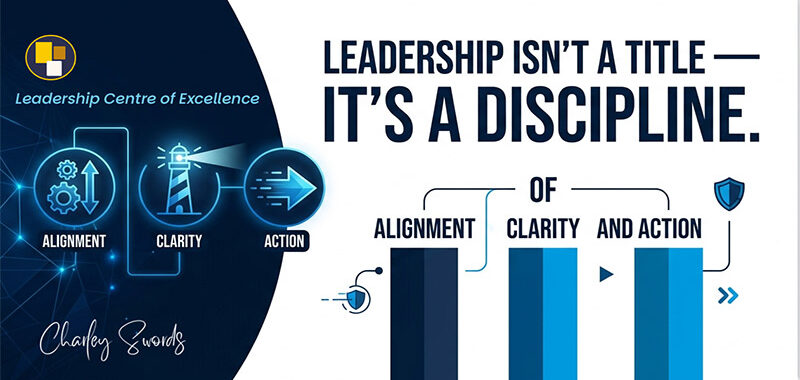
Leadership Isn’t a Title — It’s a Discipline of Alignment, Clarity and Action
There’s a hard truth most leadership teams don’t want to face:
You can have a clear strategy…
You can have a strong vision…
You can even have the right people in the room…
…and still fail to deliver results.
Not because the strategy is wrong — but because alignment, clarity, and execution are missing.
This is where most organisations quietly struggle.
From working with leadership teams across sectors, one pattern shows up consistently: leaders understand what they want to achieve, but there is a disconnect between intention and implementation. And that gap is where performance breaks down.
The Real Problem: Misalignment at the Top
Leadership teams often believe they are aligned.
They’ve agreed the vision.
They’ve signed off on the strategy.
They’ve communicated the values.
But when you look closer, there are subtle — and sometimes significant — differences in interpretation.
That lack of true alignment creates friction:
- Decisions slow down
- Communication becomes inconsistent
- Teams lose clarity on priorities
- Accountability weakens
Over time, this cascades through the organisation, leading to confusion, disengagement, and underperformance.
As highlighted in leadership practice, this misalignment is one of the biggest barriers to effective strategy execution and organisational growth.
Strategy Is Not the Challenge — Execution Is
Most leadership teams don’t struggle to create strategy.
They struggle to implement it.
Execution requires more than a document or a plan. It requires:
- Shared understanding
- Consistent behaviours
- Clear communication
- A willingness to challenge existing thinking
The reality is, parts of a strategy might succeed. But delivering the full strategy — consistently and sustainably — is where most organisations fall short.
And when execution falters, leaders often respond by adding more:
More meetings.
More reporting.
More pressure.
But rarely do they step back and ask the more important question:
Are we aligned in how we think, communicate and lead?
Leadership Starts with Self-Leadership
Before a leader can align a team, they must first align themselves.
This is where self-leadership becomes critical.
High-performing leaders:
- Understand their own decision-making patterns
- Recognise their biases and blind spots
- Take responsibility for their communication style
- Lead with intention, not reaction
Without this level of awareness, leadership becomes inconsistent — and teams feel it immediately.
Strong leadership is not about control. It’s about clarity, consistency, and conscious behaviour.
When leaders invest in self-leadership, they create:
- Greater trust
- Stronger relationships
- More confident decision-making
And ultimately, a more stable and focused organisation.
The Cost of Avoiding the Real Conversations
One of the biggest barriers to leadership effectiveness is avoidance.
Avoiding difficult conversations.
Avoiding uncomfortable truths.
Avoiding misalignment.
But avoidance doesn’t remove the problem — it compounds it.
Over time, this leads to:
- Frustration within leadership teams
- Breakdown in trust
- Poor communication across departments
- A culture of uncertainty
Effective leadership requires the courage to “interrogate” the business — to step back and honestly assess:
- Are we truly aligned on our direction?
- Are we communicating consistently?
- Are our behaviours matching our values?
Without this level of reflection, organisations drift.
Building High-Performing Leadership Teams
Leadership is not an individual pursuit — it’s a collective responsibility.
High-performing leadership teams operate differently:
- They challenge each other constructively
- They commit to shared outcomes, not individual agendas
- They communicate with clarity and consistency
- They hold each other accountable
This doesn’t happen by chance.
It requires deliberate development.
It requires space to step outside day-to-day operations and assess how the leadership team is functioning — not just what they are doing.
When leadership teams do this well, the impact is immediate:
- Clearer direction across the organisation
- Faster, more confident decision-making
- Stronger engagement from teams
- Better overall performance
Closing the Strategy-to-Performance Gap
Every organisation has a gap between strategy and results.
The question is: how big is it?
Closing that gap requires more than operational fixes. It requires leadership transformation.
That means:
- Aligning leadership thinking and behaviours
- Ensuring clarity in communication at every level
- Reconnecting strategy with day-to-day actions
- Creating accountability that drives results
When leaders commit to this level of work, the organisation shifts — not just in performance, but in culture.
Final Thought: Leadership Is a Practice, Not a Position
Leadership is not something you arrive at.
It’s something you practise — every day.
It shows up in:
- How you make decisions
- How you communicate under pressure
- How you respond to challenges
- How you lead others through uncertainty
The organisations that succeed long-term are not the ones with the best strategies.
They are the ones with the most aligned, self-aware, and committed leadership teams.
Because in the end, strategy doesn’t drive results.
Leaders do.