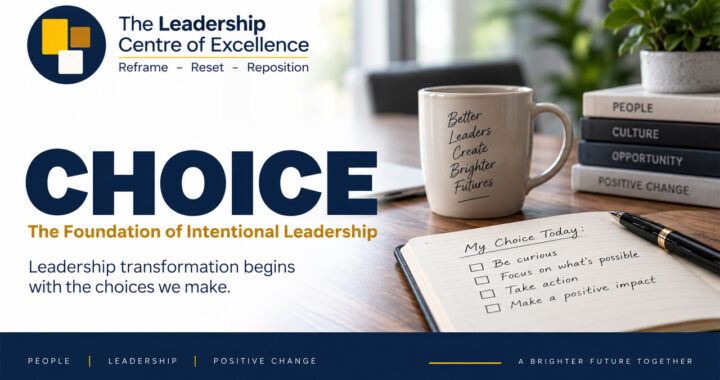
Choice - The Foundation of Intentional Leadership
Leadership transformation begins with the choices we make.
Every leader faces moments when circumstances change beyond their control. Markets shift. Organisations transform. Expectations evolve. Personal and professional challenges emerge. The question is not whether change will happen, rather: How will we choose to respond?
One of the most powerful leadership capabilities is the ability to recognise that, even when we cannot always control our circumstances, we can influence our response to them. This is where choice begins.
Leadership Starts Within. Before leaders can inspire confidence in others, they must first develop the ability to lead themselves. Self-leadership requires awareness of our thoughts, emotions and behaviours. It requires us to understand the stories we tell ourselves and whether those stories are helping us move forward or keeping us stuck.
As Edith Eger writes in The Choice, freedom is found through the choices we make in how we respond to life.
For leaders, this is a profound lesson. The quality of our leadership is shaped not only by our knowledge and experience, but by the mindset we bring into every situation.
The Challenge of Living Through Change
Periods of significant disruption often create different responses. Some people remain connected to the past, wishing things could return to how they were. Others become consumed by uncertainty about what the future may bring. And others choose to accept the reality of the present moment and focus their energy on creating what comes next. There is no simple formula for navigating change. However, leaders must recognise that where they place their attention influences how effectively they lead:
- A leader focused only on what has been lost may struggle to see new possibilities.
- A leader focused only on what might go wrong may struggle to inspire confidence.
- A leader grounded in the present can make clearer decisions and respond with greater wisdom.
Releasing the Past and Choosing to Grow
Experience and history are valuable teachers and shape our story. However, constantly comparing the present with the past prevents growth. Leaders who remain anchored in "how things used to be" may unintentionally create resistance to new opportunities. Growth requires gratitude for the past while remaining open to the future.
To ensure the past informs us, rather than imprisons us consider some useful reflection questions:
- What have I learned from previous experiences?
- What strengths have I developed because of challenges?
- What can I appreciate about where I am today?
- What opportunities exist that I may not have noticed before?
Managing the Fear of the Unknown
Uncertainty naturally creates discomfort. However, fear can either become a barrier or a signal.
Effective leaders acknowledge uncertainty without allowing it to define their decisions. To feel the fear, and move forward anyway, they tend to ask:
- What is within my control?
- What action can I take today?
- What strengths can I draw upon?
- What support do I need from others?
Courage is not the absence of fear. It is the willingness to move forward despite it.
Choosing a Growth Mindset
The most resilient leaders choose to see change as an opportunity for learning and growth. They understand that leadership is not about having everything figured out. It is about remaining curious, adaptable and willing to evolve. Some practical ways leaders can strengthen this mindset include:
- Practice gratitude - recognise what is working well to create perspective and resilience.
- Reflect regularly - understand our strengths, development areas, opportunities and potential barriers to help us make conscious choices.
- Creating space for learning - new challenges often reveal capabilities we did not know we had. Growth happens when we allow ourselves to experiment, learn and adapt – never underestimate the power of self-development.
The Leader's Choice
The greatest leadership decisions are not always strategic decisions - sometimes they are personal:
- Will I respond with curiosity or judgement?
- Will I focus on possibility or limitation?
- Will I remain connected to what matters most?
- Will I choose courage over fear?
Leadership is ultimately about choice. Every day, leaders choose the energy they bring, the behaviours they demonstrate and the impact they create.
The most effective leaders understand that transformation does not begin with changing everything around them. It begins with the choices they make within themselves. The leaders who can lead themselves with intention are the leaders who can create the confidence, capability and belief needed for others to see them as impactful role-models and to subsequently transform their own way of behaving.